
The seating chart often becomes difficult at the exact moment it needs to be final: RSVPs have changed, a table has been removed, and someone has remembered a family disagreement from 2014. A clear wedding seating plan example gives you a workable structure before those last-minute details turn into spreadsheet chaos.
The goal is not to make every table perfectly identical. It is to create a room that feels considered, keeps important relationships in mind, and works for guests, venue staff and your timeline. Start with a sensible framework, then adjust it using the details only you know.
A wedding seating plan example for 80 guests
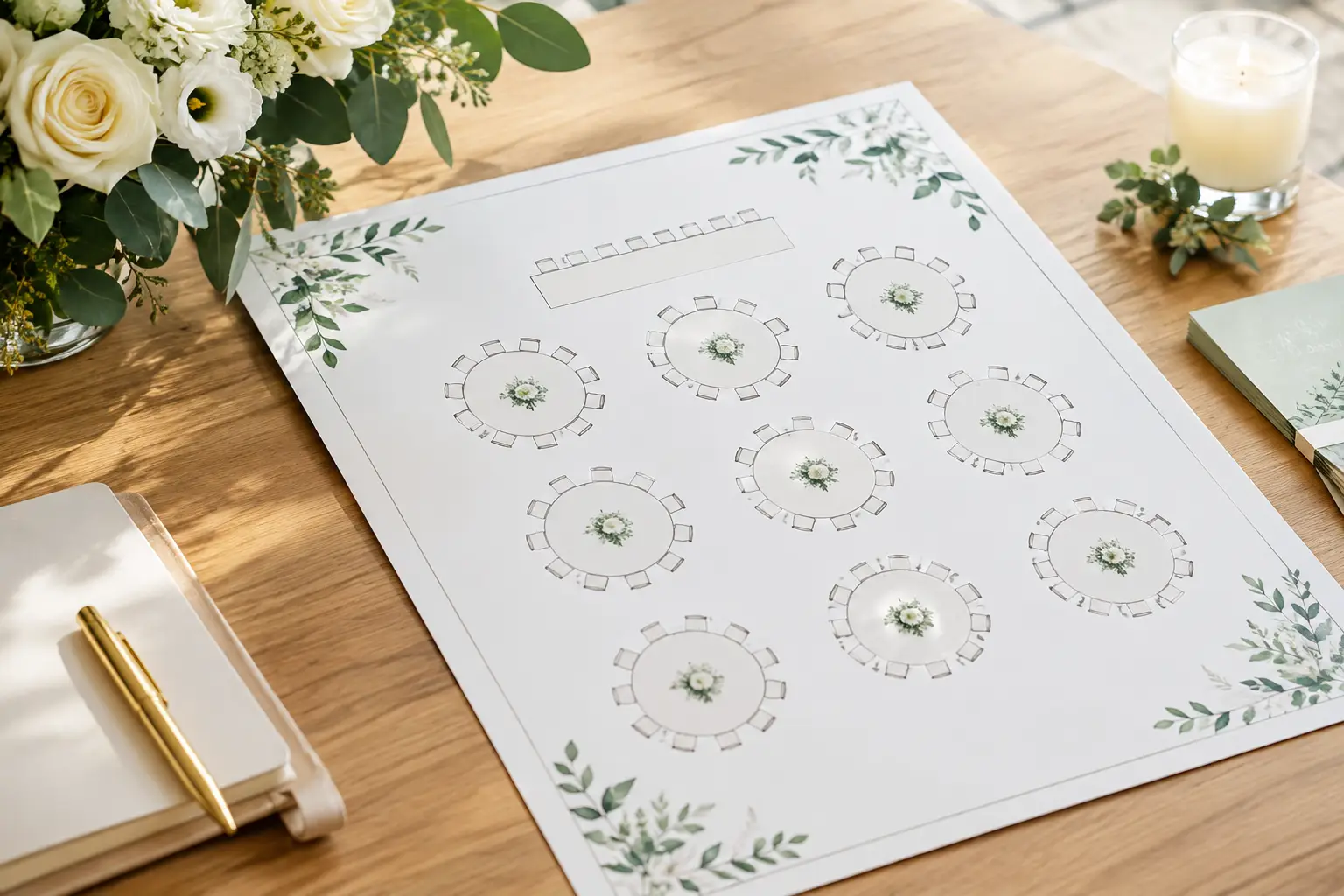
Imagine an 80-person wedding reception with eight round tables of 10. The couple want close family nearby, friends grouped by shared history, and older relatives seated away from the speakers and main foot traffic. The head table sits at the front of the room, with clear access to the dance floor.
This is a starting structure, not a rulebook. A table of six may be the better choice if it gives grandparents room for mobility aids or avoids forcing two people into an awkward pairing. If the venue charges per table, you may prefer to redistribute those guests - but only if the mix remains comfortable.
Start with the room, not the guest list
A good seating plan begins with physical constraints. Confirm the room layout, table shapes, guest capacity, entry points, buffet or bar location, stage, dance floor and any accessibility requirements. A beautiful guest grouping can still fail if it places older guests beside a loud speaker or puts a wheelchair user where there is no clear route to their seat.
Mark the high-priority positions first. This normally includes the couple, wedding party, immediate family, elderly guests, guests with access needs and anyone giving a speech. Where you put parents depends on the family dynamic. Some couples prefer one head table; others choose a sweetheart table for two and place each set of parents at separate nearby tables. Neither option is more correct. Choose the arrangement that makes the people involved feel most at ease.
For a traditional top table, consider sightlines as well as symbolism. Keep speakers close enough to access the microphone easily and avoid placing anyone directly behind floral displays, signage or equipment that blocks their view.
Use zones before assigning individual seats
Rather than placing all 80 names one by one, organise guests into broad zones first: family, wedding party, long-standing friends, workmates and social groups. This immediately shows which tables naturally belong close together.
For example, Tables 3 and 4 can sit beside one another if both hold friends likely to move between tables during the night. Immediate family tables may be closer to the front, while a quieter corner can suit grandparents or guests bringing young children. Zoning reduces the chance that people feel isolated, without making the room look divided into separate camps.
Want to turn this guide into a real seating chart in minutes?
Vesavo handles messy guest lists and builds smart table arrangements automatically. Free for up to 50 guests.
Build each table around natural connections
Every table needs a few genuine social anchors - people who know others and are comfortable including new faces. Start with those anchors, then add partners, close friends and people with obvious shared ground.
Avoid the temptation to fill a table by age alone. Two guests in their thirties may have little in common beyond the date on their birth certificate, while a mixed-age table of cousins, neighbours and friends can be lively because the connections are real. Shared interests, travel history, family ties and whether guests already know each other matter more.
Couples should generally sit together, unless there is a reason they have asked otherwise. Keep families with young children near the people most likely to help them, rather than treating them as a separate category. And do not use one guest as a social bridge for five strangers simply because they are outgoing. That is a lot to ask over a three-course meal.
A useful test is this: could each person at the table comfortably name at least two people they would be happy to talk with? If not, move one or two guests before trying to redesign the whole chart.
Treat sensitive relationships with care
Weddings bring different families, friendship circles and histories into one room. Seating is not the place to solve a conflict or prove a point. If two guests have asked not to sit together, respect that request quietly. If a separation is recent, give both people supportive company rather than placing them at opposite ends of a highly visible table.
Distance is not always the answer. Some divorced parents can sit at the same table comfortably, particularly with new partners and adult children present. Others will have a much better evening at nearby tables. Ask the people closest to the situation, and keep the question practical: what arrangement will allow everyone to enjoy the celebration?
For guests who know no one, place them with a warm group and at least one person with a clear connection. A colleague who has met the couple through work may fit better with other work friends than at a table of distant relatives, even if both groups are similar in age.
Move from table plans to individual seats when needed
A table assignment is enough for many relaxed receptions. Individual place cards become more valuable when tables are long, dinner service is formal, dietary needs need careful tracking, or particular guests need seats with easy access.
At a round table, avoid making one side feel like an accidental singles' row. Alternate familiar pairs with guests who will get along, and keep conversations balanced across the table. At long banquet tables, think about who sits opposite each other as well as side by side. People tend to speak most easily across a narrow table, so the pairing matters.
Make a simple note against each guest name for dietary requirements, accessibility, children, high chairs and any priority relationship information. This protects details from being lost between your guest list, seating chart and venue briefing.
Tip: Vesavo can do this for you automatically — just upload your list and let the AI handle groupings, plus-ones, and table balance.
Check the plan against service and the guest experience
Before you finalise anything, look at the plan from the venue team's perspective. Can staff reach every chair? Are children away from busy service routes? Does each table have enough room for guests to stand and move? Are dietary requirements clearly connected to the right seat?
Then look at it as a guest. Can they find their table quickly? Is the table naming system obvious? Is there a clear path from the entrance to the seating display? A plan that is perfect behind the scenes can still create a bottleneck if 80 guests arrive at once and cannot locate their names.
Digital planning is especially helpful here because changes are inevitable. A structured seating tool lets you import a guest list, group people by relationship or preference, update attendance and test table capacity without rebuilding the plan from scratch. With Vesavo, those details can carry through to polished table plans, place cards and Canva designs, rather than being copied manually between files.
Finalise later than you think, print earlier than you expect
Leave the seating plan editable until the RSVP deadline has genuinely passed, then set a firm internal cut-off with your venue. A final check around one week before the wedding is usually sensible, but the right timing depends on your caterer and stationery arrangements.
Export or print your final version with enough time to check spelling, table numbers and any late guest changes. Keep one master version so the venue, coordinator and wedding party are not working from different charts.
The best seating plan is not the one that looks most symmetrical on screen. It is the one that lets guests sit down, spot familiar faces, and spend the night celebrating without ever noticing how much planning made that ease possible.