
The moment someone says "you can't put Uncle David at my mum's table" is often when the seating plan becomes personal and that's why wedding table seating etiquette is important. It's not about sticking to rigid old-style rules, it's about making guests feel more relaxed, preventing unnecessary confrontation and making your reception run a bit smoother.
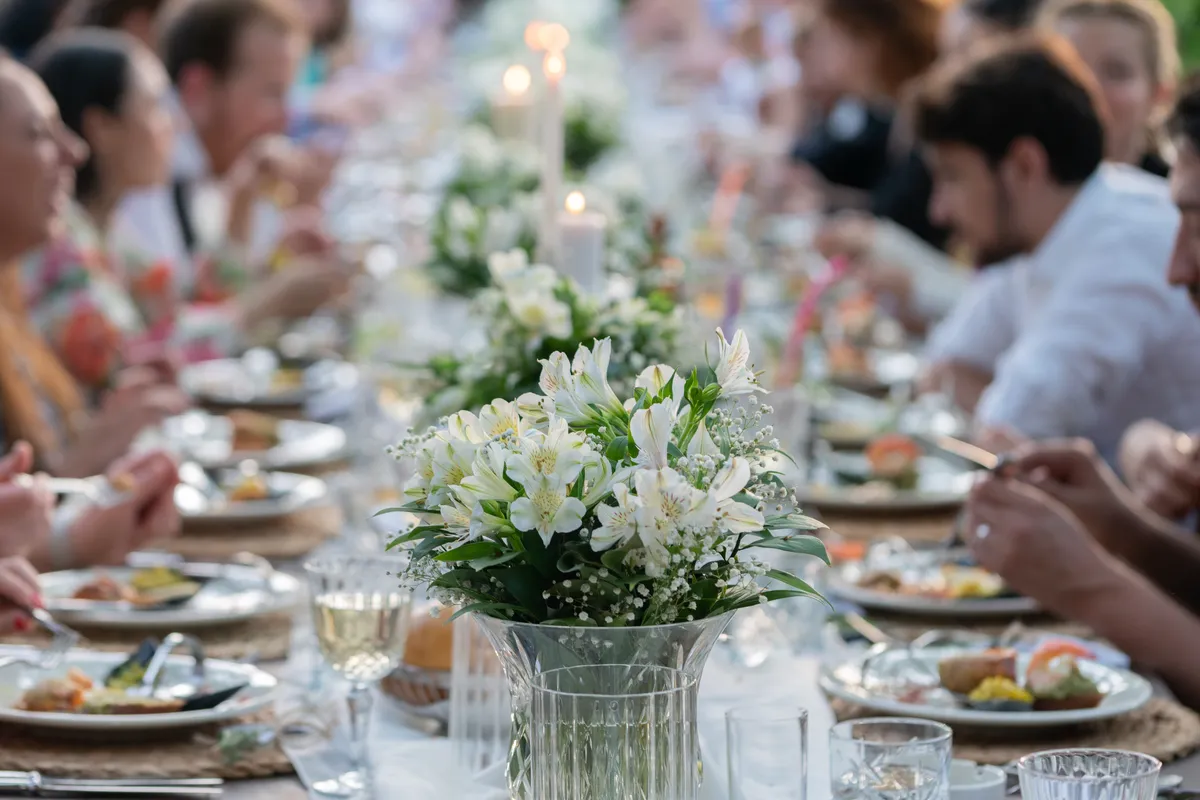
The seating plan does two things at the same time. It honours relationships and it helps your wedding reception run smoothly. Get those two things right and your room will feel relaxed, get them wrong and you're left with a really awkward wedding even in a perfect venue.
What is wedding table seating etiquette?
At its simplest, the art of wedding table seating etiquette is putting people in the most appropriate places at your reception. We're talking about immediate and extended family, bridal party guests, senior citizens, work colleagues and friends from different parts of life plus all of your plus-ones too. There is no need to stick by social etiquette when it comes to your seating plan, you just need to make sure everyone at your wedding has somewhere to sit where they can chat away to people they enjoy, people that make them feel comfortable.
In reality that means there's an element of both social and logistical thinking to do. There's not only a matter of who gets on with whom, you also need to think about good views from the table to the speeches, where the elderly will have an easy time getting up to their seats, the location of restrooms, how easy it is for parents with little ones at the wedding to reach their tables and so on. A good mix of these things is the key to making everyone relaxed.
Some etiquette and tradition will still apply, but there are definitely ways to mix it up in these new times. Many couples opt for a sweetheart table and leave the family and bridal party to find their own places, or they could put the bridal party round the top table for an extra special feeling or a long top table where everyone sits together. If it's a same-sex wedding, or you have one half of the party who is blended in from a second marriage, for example, you may feel it better to mix things up. But at the heart of wedding table etiquette is respect for what the people attending want, and working on your seating plan according to those people.
Seat the most sensitive guests first
There's nothing worse than you sitting the most basic family tables at your wedding first then spending the evening trying to work out where to sit the complicated people. The more logical way is to sit the most complicated family members at your wedding before moving on to the next tier of difficulty. That usually means parents, step-parents, grandparents, the bridal party and anything with complex guest relationships at the wedding.
This can sometimes happen when there is divorced parents at the reception. A couple of families are fine putting them together at the same table, whereas others aren't so even if they're all being really kind about it. If having them together causes unnecessary tension and it goes against wedding seating etiquette it's okay not to put them together. It's just better if it calms everyone down. The same with any relatives in the family who haven't spoken, or ex-lovers in the same friend circle. If any guest is going through any relationship turmoil, don't sit them at the same table. It's not the place to resolve things, it's there to make them better. This is the only way to work things.
Once you've done all of these placements you can sit the rest of the reception much easier.
A top table or a sweetheart table?
There's no perfect place but there is a place that is perfect for your wedding. A traditional top table usually has the bride and groom and their parents at the wedding and sometimes it can include the maid of honour and best man. This is particularly appropriate for traditional wedding ceremonies and family-centered weddings. It allows specific guests to be highlighted, and it makes assigning the order of speeches easier. A head table that features the bridal party generates enthusiasm and is very appropriate for those who want a social and modern setup. It can also help with the difficult decision of how to separate parents/step-parents. A sweetheart table is the easiest option from a practical perspective. It allows a brief, calm moment for the couple in public, and it provides flexibility with how guests in the rest of the room (especially the family) will be seated. It removes the need for the couple to decide where each parent (and, in the case of re-married parents, how many) are to be seated. That said, some parents may have expected to be included as part of a more traditional arrangement, so be prepared to clearly explain your plan to them should you choose this setup. Again, this question is less about etiquette and more about understanding what your guests expect. If any of these seating options could be a surprise for a close family member, make sure to talk about it ahead of time and don't expect them to sort it out for themselves on the day of the reception.
Want to turn this guide into a real seating chart in minutes?
Vesavo handles messy guest lists and builds smart table arrangements automatically. Free for up to 50 guests.
Seat by relationship, age, and energy level
Guests don't have to be familiar with one another to enjoy themselves, but they will need something in common in order to get into conversation. This means that they should generally be divided in layers. Friends of a similar age will get on very well, particularly if they are of similar social energy. Elderly family members will be comfortable with a table that isn't too loud, is close to the buffet, and has plenty of familiar faces. Work colleagues will enjoy sitting together, although it might be better to avoid a table that is too much like an office extension if the evening's aim is to be more fun and relaxed. Ideally, married and engaged couples should always sit together. Dividing them up was a very common practice decades ago, especially at formal weddings, but nowadays it is rarely appropriate and is usually a bit of an inconvenience. The same goes for "plus ones". A couple attending a reception together will likely be happier if they remain seated with one another, especially if one of them doesn't know any of the other attendees and is likely to be alone at any other table. Singles should also receive special consideration. There is no need to place all the single attendees together in case they think it's some sort of singles' mixer. Sometimes it is more appropriate to have a mixed table that includes some friendly and sociable guests than a designated singles' table.
Don't overlook practical placement
It is not only a case of who you sit where – it is also a case of where you sit. In this sense, older generations, pregnant women, and guests with mobility issues should always be seated at the most accessible table on the plan. Families with small children may wish to sit at a table that has the space for a pushchair or that is close to a door or bathroom. Anyone with hearing issues will be better suited to a table that's a distance from the band or speakers. In general, VIP family members should always have a clear view of any speeches, and guests who love to dance should preferably be seated closer to the dance floor, while guests who are more likely to spend time talking will probably prefer a location away from loud music. These are small decisions but they are the difference between guests feeling attended to or not. A well-crafted seating plan needs to be socially appropriate and mindful of the room's layout.
Seating children at weddings
It is generally easy to seat kids or, depending on their age, it can be surprisingly challenging. In this instance, it will depend on the formalness of the event, and whether parents want the children close. Young kids are better off with their parents; if you are expecting some older children, you may find that a separate kids’ table, or cousins’ table as it is sometimes called, is the way to go. Not only does a separate area give children a greater sense of freedom, but it can also alleviate the risk of having to squeeze a whole family onto a tiny corner chair. The only issue with this solution is that it is dependent upon both the guests and the venue setup; you must make sure you are inviting older enough guests and the space is suitable. If you have many families attending, you want the children to have a consistent arrangement across the board. You want to make sure that you are not treating some families with an extra high chair and the others are squeezing their own into a small area.
Seating charts, place cards and flexibility
For a larger wedding, a seating chart will be the most popular option to manage guests in the most effective way, as it is easier for guests to locate their seats and prevents those dreaded crowds at the entrance of the venue trying to locate each other. For the same reason, placing place cards is another way to ensure each guest is directed to their right table. This is useful if the table arrangement is crucial, such as for the top table or family table. For smaller weddings, a seating plan by table only is usually sufficient. In most cases, your guests are happy to pick their own table seat when they arrive, especially for simple party groups. If your guest list is not finalised, or there is significant room for last-minute changes, you will need to have a system in place for updates. If there are many last-minute additions or changes, including dietary requests, or guests’ party groupings, then a digital planning solution is the way forward so you do not waste time changing things manually. A solution like Vesavo takes a lot of the guess work and spreadsheet stress out of seating arrangements.
Tip: Vesavo can do this for you automatically — just upload your list and let the AI handle groupings, plus-ones, and table balance.
Common mistakes that create avoidable awkwardness
The vast majority of problems with table seating plans are because the couple or planner has tried to do the best and not considered all the different angles. Trying to treat everyone equally can mean not knowing who is sitting next to who. Trying to avoid the issue because ‘they will be OK’ can end in a disaster. Not seating your elderly guests in the right place is rude and could be seen as deliberate. Many couples have a desire to have an even spread of people throughout the room and make sure that they are sitting with people that they know. Some couples have tried to arrange guests so they can achieve the same size, gender ratio or family split on each table. While there is nothing wrong with that, a balanced seating plan does not necessarily translate to an evenly seated room, as the room dynamics and interactions should be taken into consideration. A few guests will feel happier in certain tables over others, and some people just want to sit near people they know, especially at an emotional event like a wedding.
The best etiquette rule is clarity
The best advice that can be given, which is often ignored in practice, is this: treat your guests with consideration. Your guests need to feel considered, not controlled. A well-planned seating plan should not need to be explained, and if you have done it properly, no guest will have any questions. It is not possible to please everyone, nor is it realistic to try and avoid every conflict. So what you can do is make calm and considered decisions, thinking about family relationships and comfort and where people will feel comfortable. This will ensure that each and every table has a sense of purpose. This will create the most effective and relaxed atmosphere throughout the night.