
Guests should be able to find their table before they have time to wonder whether they are in the right room. That is the real job of table plan signs for wedding celebrations: not just to look beautiful in photos, but to move people from arrival to conversation with no bottleneck at the entrance.
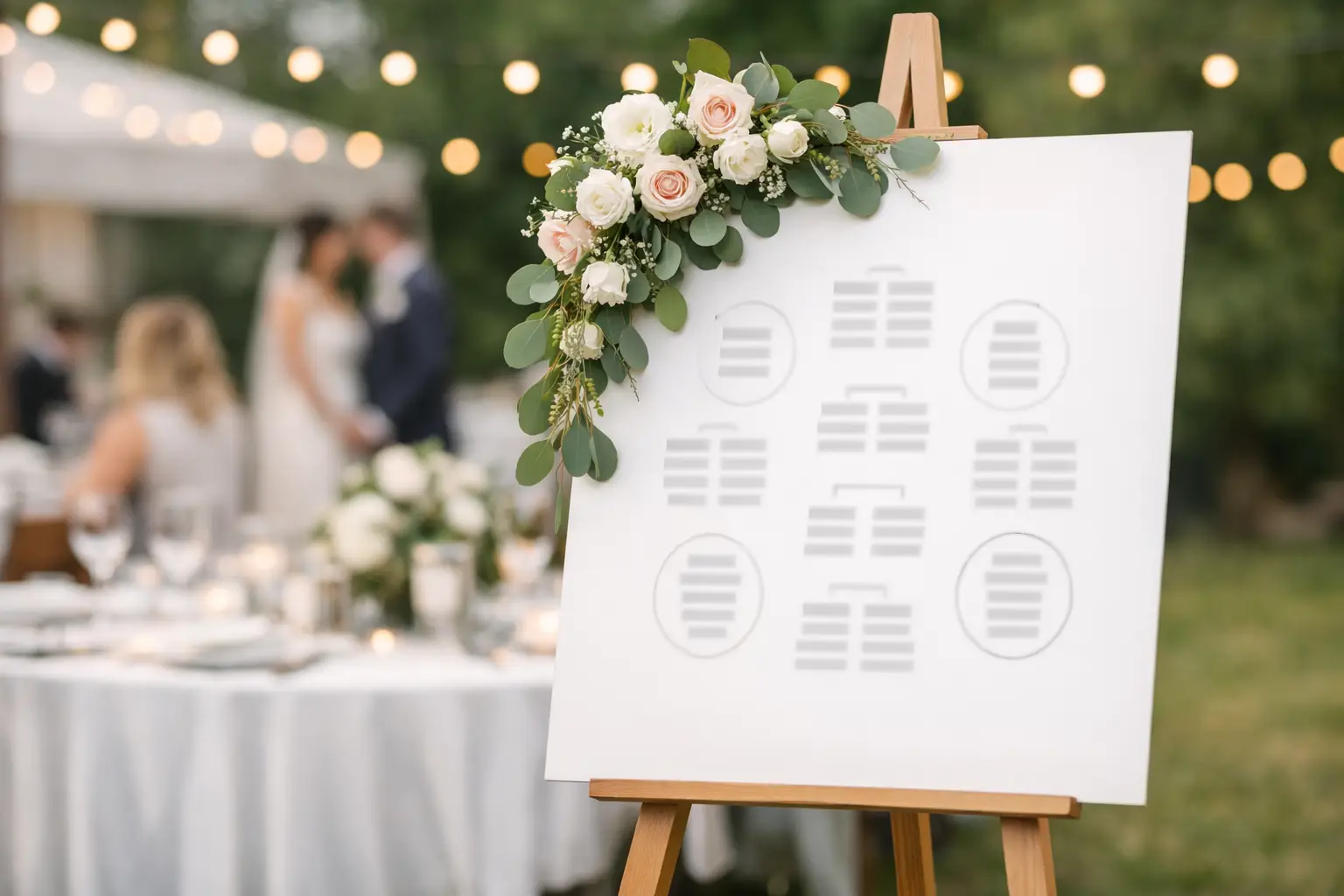
A well-designed table plan turns a potentially awkward moment into a calm one. It gives guests a clear answer, helps the venue team direct traffic, and protects the atmosphere you have worked hard to create. The best choice is rarely about following a trend. It is about matching the sign format, layout and placement to your guest count, venue and seating plan.
Choose the table plan format before the design
Start with how guests will search for their names. This decision should come before fonts, florals or frame colours, because it determines whether the sign works under real event conditions.
For weddings with assigned tables but open seats, a table plan is usually the simplest option. Guests find their name, then see the table number or table name beside it. This suits most receptions and gives people enough flexibility once they reach their table.
For fully assigned seating, use a seating chart or escort-card-style display that shows each guest's table and seat. This is useful when formal service, dietary requirements, family dynamics or a tightly managed floor plan makes a specific seat necessary. It takes more data and more checking, but it removes uncertainty for guests and staff.
A single large sign works well for smaller weddings and rooms with a clear entry point. For larger guest lists, multiple panels are easier to scan. Splitting the display alphabetically, by table range or into two matching boards can prevent a crowd forming in front of one sign. There is no prize for fitting 180 names onto one board if nobody can read it.
Alphabetical names are usually fastest
Guests think in names, not table numbers. Listing everyone alphabetically by surname is generally the quickest route to their table, especially when guests arrive in mixed groups.
Grouping names under each table can look elegant and is useful for an intimate wedding where guests know one another. It becomes slower at scale, since each person has to search through every table heading. A practical compromise is an alphabetical index on one panel and a table-by-table display on another, although that only makes sense if there is enough room and budget for both.
Make table plan signs for wedding guests can scan
A wedding sign can be beautifully styled and still fail as wayfinding. Readability needs to lead the design decisions.
Use high contrast between the text and background. Dark lettering on a pale background is usually the safest choice, particularly in venues with low evening light. Fine metallic lettering, pale ink on a textured surface or reflective acrylic may look striking in a close-up photo but can become difficult to read from a step away.
Keep names large enough for guests to read without leaning in. The right size depends on the viewing distance and number of entries, but if the layout forces tiny type, the answer is more panels, a larger board or a shorter display format. It is not a smaller font.
Decorative type has a place in table headings and the couple's names. Use a simple, clear font for the guest list itself. Avoid all caps for long lists, and leave generous spacing between lines and columns. Guests scanning after a drink, while holding a clutch or trying to keep an eye on children, will appreciate every bit of breathing room.
Table names deserve the same consistency as table numbers. If you are using places, wines, songs or meaningful locations, make them unambiguous and easy to distinguish. “Barossa” and “Bordeaux” may fit a wine theme, but they can be misread quickly in a busy room. A small table number paired with each themed name gives guests and staff a reliable backup.
Build the sign from a finalised guest list
The most common table-plan problem is not a printing error. It is designing too early, then trying to patch late RSVPs, changed surnames and table moves into a finished layout.
Set a clear cut-off for print-ready names and use one source of truth for the guest list. Confirm spelling, preferred names, couples, plus-ones and children before exporting the sign. If a guest is known socially by a nickname but their invitation uses a formal name, choose the version they are most likely to look for on arrival.
This is also where seating logic matters. A table plan is the visible output of dozens of decisions: who should sit together, who needs space, where older relatives can comfortably access their seats, and which tables suit speeches or the dance floor. If the underlying list is scattered across messages, spreadsheets and supplier notes, the sign is more likely to be wrong.
Vesavo helps bring that work into one place, from guest-list import and seating assignments through to polished table-plan exports. When the guest list changes, the plan can be updated before you commit it to print, without rebuilding every column by hand.
Check the details that cause day-of confusion
Before sending the file to print, review the sign as a guest would. Search for common surnames, couples with different surnames and names with apostrophes, hyphens or diacritics. Confirm every table on the sign exists in the room layout, and every occupied table appears on the sign.
Then ask someone who did not build the seating plan to test it. Can they find three names quickly? Can they tell whether “Table 12” is twelve or one-two in the chosen font? A fresh pair of eyes will spot issues that are invisible after hours of editing.
Place the sign where decisions happen
The ideal location is at the point where guests need to know where to go, not tucked beside the gift table because it suits the styling. Place the table plan just inside the reception entrance or at the transition between cocktails and dinner, with enough space for several people to stand back and read it.
Think about light, too. A sign positioned in direct afternoon sun can be hard to photograph and difficult to read. At night, nearby lighting should illuminate the guest list without creating glare on glass, acrylic or gloss stock. Ask the venue whether the sign location will remain clear once doors, furniture, welcome drinks and staff stations are in place.
For a large wedding, consider two identical signs on separate easels or walls. This is especially helpful if guests enter from different sides of a foyer. It costs more, but can save the first ten minutes of the reception from feeling like a queue.
Match the finish to the venue, not just the mood board
The material should support the setting and the event timetable. Framed paper or foam board can look refined and is easy to transport. Fabric banners suit relaxed outdoor settings, provided they are weighted and protected from wind. Acrylic and mirror finishes create a premium look, but require careful attention to glare and legibility.
A digital seating display can be useful for corporate events or very large guest counts, particularly where changes may occur close to doors opening. For a wedding, it can work beautifully as an additional search point, but a printed sign remains reassuring when connectivity, batteries or screen brightness are not guaranteed.
Do not overlook the practical extras. Confirm the easel is stable, the sign will fit in the car, and the venue knows who is setting it up. Bring a small printed backup of the guest-to-table list for the coordinator or host. It is a simple safeguard if a sign is damaged in transit or a last-minute adjustment needs explaining.
Give guests a clear next step
A table plan does not need a paragraph of instructions. A short heading such as “Find Your Table” and a clear alphabetical list are enough. If the names are listed by table, say so plainly. If tables are in another room, add a discreet directional cue.
The strongest table plan signs do their job quietly. Guests find their name, head to the right table and begin celebrating. That is one less decision for them, and one less thing for you to manage on a day that should feel effortless.